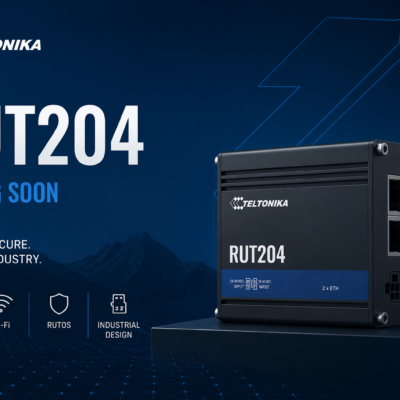
Teltonika RUTC54 – Global 5G Edge Router with Docker, Wi-Fi 6 and GNSS
The Teltonika RUTC54 is a global 5G edge router launched in July 2026. It sits on Teltonika’s C-series platform – the only Teltonika range that runs Docker containers directly on the hardware – and uses a global Telit 5G modem rather than the region-specific module found in the RUTC50. In Teltonika’s naming convention, the trailing “4” signals the Telit global variant, mirroring the relationship between the RUTM50 and RUTM54.
The RUTC54 combines Sub-6 GHz 5G (SA and NSA) at up to 3.4 Gbps download via 4×4 MIMO, dual-band Wi-Fi 6, five Gigabit Ethernet ports, RS232 and RS485 serial interfaces, five-constellation GNSS, digital I/O, USB, and TPM 2.0 security – all in an anodised aluminium housing rated from -40 to +75 degrees C. It runs RutOS on a dual-core ARM Cortex-A53 processor with 1 GB DDR4 RAM and 8 GB eMMC flash, providing the compute headroom required to run containerised edge applications alongside the full routing stack.
Why Docker on a Router Matters
The headline capability of the RUTC series, and the reason the RUTC54 exists as a distinct product line from the RUTM54, is Docker container support. This allows engineers to deploy containerised applications – Node-RED, protocol converters, local dashboards, lightweight analytics, data buffering for intermittent connectivity, or custom integration logic – directly on the router hardware. Two boxes at each remote site become one. One power supply, one set of mounting hardware, one device to manage via Teltonika RMS.
This matters most in distributed estates where truck rolls are expensive: substations, solar farms, remote cabinets, transport infrastructure, and retail branches. Running logic at the edge reduces cloud dependency, trims latency for time-sensitive tasks, and keeps a site operational even when the backhaul drops.
Global 5G Cellular Connectivity
The Telit 5G modem supports Sub-6 GHz 5G in both Standalone (SA) and Non-Standalone (NSA) modes, with download performance rated up to 3.4 Gbps on 4×4 MIMO. Backward compatibility with 4G LTE Cat 19 (up to 1.6 Gbps download) and 3G ensures connectivity where 5G coverage is still building out. The global modem covers a wide range of 5G NR and LTE bands across Europe, North America, Asia-Pacific, and Latin America from a single hardware SKU.
5G NR Bands: n1, n2, n3, n5, n7, n8, n20, n25, n28, n30, n38, n40, n41, n48, n66, n71, n77, n78, n79
4G LTE FDD Bands: B1, B2, B3, B4, B5, B7, B8, B12, B13, B14, B17, B18, B19, B20, B25, B26, B28, B30, B34, B66, B71
4G LTE TDD Bands: B38, B39, B40, B41, B42, B43, B48
3GPP Release: 16
SIM & eSIM
The RUTC54 has two physical Nano SIM slots (4FF) plus a built-in consumer eSIM supporting up to 7 downloadable profiles. Automatic failover between SIM sources is triggered by weak signal, data limit, SMS limit, roaming, no network, network denied, data connection failure, or SIM idle protection. The eSIM supports bootstrap provisioning for zero-touch deployment.
Hardware Specifications
| Cellular | 5G Sub-6 GHz SA/NSA: up to 3.4 Gbps DL (4×4 MIMO) / 900 Mbps UL (SA) – 3GPP Release 16 |
| 4G Fallback | LTE Cat 19: up to 1.6 Gbps DL / 211 Mbps UL |
| 3G Fallback | 42 Mbps DL / 5.76 Mbps UL |
| SIM | 2 x Nano SIM (4FF) + Consumer eSIM (up to 7 profiles) |
| Ethernet | 5 x RJ45 Gigabit (1 WAN configurable + 4 LAN), 10/100/1000 Mbps |
| Wi-Fi | 802.11b/g/n/ac/ax (Wi-Fi 6), dual-band, MU-MIMO, up to 2,402 Mbps on 5 GHz / 576 Mbps on 2.4 GHz, up to 512 simultaneous clients |
| Serial | RS232 + RS485 |
| GNSS | GPS, GLONASS, BeiDou, Galileo, QZSS (5 constellation) |
| I/O | 1 x Digital Input, 1 x Digital Output (on 4-pin power connector) |
| USB | 1 x USB 2.0 Type-A |
| TPM | TPM 2.0 |
| Antenna Connectors | 4 x SMA (cellular), 3 x RP-SMA (Wi-Fi), 1 x SMA (GNSS) |
| CPU | MediaTek dual-core ARM Cortex-A53, 1.3 GHz |
| Memory | 1 GB DDR4 RAM, 8 GB eMMC Flash |
| Power | 9-50 VDC, 4-pin industrial connector, passive PoE on LAN1 (Mode B, 9-50 VDC, non-standard) |
| Operating Temperature | -40 to +75 °C |
| Humidity | 10-90% non-condensing |
| Housing | Anodised aluminium, IP30 |
| Dimensions | 130.4 x 42.6 x 103.4 mm (excluding antenna connectors) |
| Mounting | DIN rail, wall mount, flat surface (mounting kits sold separately) |
Docker & Edge Computing
The C-series hardware – 1 GB DDR4 RAM and 8 GB eMMC flash on a dual-core ARM Cortex-A53 – provides the compute headroom to run Docker containers alongside the full RutOS routing stack. Docker is installed via the RutOS Package Manager. Any application with an ARM-compatible container image that fits within the device’s resource limits can be deployed. Common workloads include Node-RED for visual logic flows, protocol translation between legacy serial equipment and modern cloud platforms, local data filtering and aggregation, lightweight analytics, and MQTT bridging.
Software & Protocols
Routing: Static, BGP, OSPF, RIP v1/v2, policy-based routing.
VPN: OpenVPN (client/server), IPsec (IKEv1/v2), WireGuard (client/server), ZeroTier, Tailscale, GRE, PPTP, L2TP, Stunnel, DMVPN, SSTP, Tinc.
Industrial Protocols: Modbus TCP (client/server), OPC UA (client/server), DNP3 (station/outstation), DLMS/COSEM (client), MQTT (broker and publisher), Data to Server (HTTP/S, MQTT, Azure MQTT, Kinesis).
Security: WPA3, 802.1x, RADIUS, TACACS+, VLAN (port and tag-based), DDoS prevention, certificate manager (CA, Let’s Encrypt, SCEP), TPM 2.0.
Wi-Fi: Wireless mesh (802.11s), fast roaming (802.11r), BSS transition management (802.11v), radio resource measurement (802.11k).
Cloud Integration: Teltonika RMS, Azure IoT Hub (with Device Provisioning Service), AWS IoT Core (with Jobs), ThingWorx, Cumulocity.
Management: WebUI (HTTPS), SSH, SNMP v1/v2/v3, TR-069, MQTT broker, JSON-RPC, FOTA, SMS management, email alerts.
Container: Docker via RutOS Package Manager.
GNSS & Location
The five-constellation GNSS receiver (GPS, GLONASS, BeiDou, Galileo, QZSS) provides positioning via the WebUI, SMS, NMEA output, or Teltonika RMS. Geofencing with configurable zones enables location-based triggers and alerts. The dedicated SMA GNSS antenna connector is on the rear panel.
Serial Interfaces
RS232 and RS485 serial ports connect to legacy industrial equipment, enabling serial-over-IP tunnelling, console access, modem emulation, and Modbus RTU gateway bridging. RS485 supports full and half duplex configurations.
Certifications & Availability
At launch (July 2026), the RUTC54 is certified on FCC and ISED (IC), and is certified for use on Verizon. Certification on T-Mobile and AT&T is expected in Q4 2026. CE and UKCA certification status should be confirmed with your distributor for European deployments.
The RUTC54 is expected to be available from end of August 2026.
Ordering Codes
Ordering codes to be confirmed at launch. Based on the RUTC platform convention, expect variants for EU, UK, US, and AU PSU, with eSIM availability on specific order code variants (typically *1**** codes).
What’s in the Box
Based on the C-series platform: RUTC54 router, power supply (region-specific), 4 x 5G mobile antennas (SMA), 3 x Wi-Fi antennas (RP-SMA), 1 x GNSS antenna (SMA, adhesive), Ethernet cable (1.5 m), SIM adapter kit, Quick Start Guide. Mounting kits sold separately. Confirm box contents with official datasheet at launch.
RUTC54 vs RUTC50
The RUTC54 and RUTC50 share the same C-series platform – identical housing, processor, memory, Ethernet, Wi-Fi 6, Docker support, I/O, and serial interfaces. The difference is the cellular modem: the RUTC54 uses a global Telit 5G modem covering a wide range of bands worldwide from a single SKU, while the RUTC50 uses a region-specific module requiring different hardware variants for different markets. For multi-region or global deployments, the RUTC54 simplifies procurement, spares management, and configuration standardisation.
RUTC54 vs RUTM54
Both use the same global Telit 5G modem. The RUTC54 adds Docker container support, Wi-Fi 6 (vs Wi-Fi 5 on the RUTM54), higher processing power (1 GB DDR4 + 8 GB eMMC vs the RUTM series), and serial interfaces (RS232 + RS485). The RUTM54 is the connectivity-focused 5G router; the RUTC54 is the edge computing gateway.
Typical Applications
Edge computing at distributed sites (substations, solar farms, BESS), industrial IoT gateway with local Docker workloads, smart city infrastructure with 5G backhaul and Wi-Fi 6 local access, transport and fleet connectivity with GNSS, retail branch networking requiring combined 5G failover and local application logic, SCADA and building automation with Modbus/DNP3 serial bridging, and any deployment that previously required a cellular router plus a separate edge gateway or industrial PC.
eSIM Note
The RUTC54 uses a consumer-grade eSIM implementation (SGP.22), not the IoT-grade SGP.32 remote provisioning standard. This is adequate for most commercial deployments but may be a consideration for large-scale IoT estates requiring full remote SIM lifecycle management. Physical SIM remains available as the primary connectivity method.